
“Iris Shalewa Morris.” I said my name aloud, almost like a whisper, as I flipped through old baby pictures. There I was—full cheeks, a head of thick hair, eyes wide and full of wonder. I smiled faintly, then sighed. What would I even tell that little girl now?
“Iris, Samuel! Time for school!” my mother called.
I groaned and grabbed my bag. Another day. Another struggle.
High school had only just begun, but I already hated it.
My brother, Samuel, was popular—always surrounded by people who admired him. As for me? I was just “his little sister,” a shadow barely noticed.
“Freshers’ Week” had arrived, and the seniors had their own twisted way of making us feel welcome. We were lined up in the middle of the cafeteria, one by one being called ahead to entertain the crowd. When my turn came, I danced—putting all my effort into it. But as the music played, so did the laughter.
“She really thinks she can dance?” someone jeered.
Laughter erupted all around me. Cruel. Loud. Unrelenting.
Before I could slip away, another voice stabbed through the noise:
“Iris, did you hear? That guy said you’re ugly.”
Something shattered inside me. I had never felt so small. So invisible. I turned and ran—straight into Samuel. I didn’t mean to embarrass him in front of his friends, but in that moment, I just needed safety. I watched helplessly. He and his friend confronted the boy who had insulted me. However, the damage was already done.
That one comment planted a seed—a lie that took root quickly. A mask that began to form. I began questioning everything: my beauty, my value, even my intelligence. I tried to keep it all inside, hoping it would go away. But the ache only grew.
“Can I sit with you guys?” I asked one lunchtime, trying to blend in with the popular kids.
They smiled. But then came the whispers.
“Did you hear? She’s poor.”
Poor? We all paid the same tuition. We wore the same uniforms. But suddenly, I was the outsider again. The one who didn’t belong.
I kept the pain to myself, never telling my family. But inside, a broken heart was crying for safety—longing to be seen and known. I started searching for comfort in the wrong places, often in the arms of boys who didn’t care. Each toxic relationship promised validation but left me emptier than before.
Then came the announcement:
“Attention students! Our Freshers’ Dance is only a few weeks away! Come dressed to impress!”
Everyone was excited—except me. The last thing I wanted was to be seen. Thankfully, it was a masquerade ball. I didn’t have to show my face.
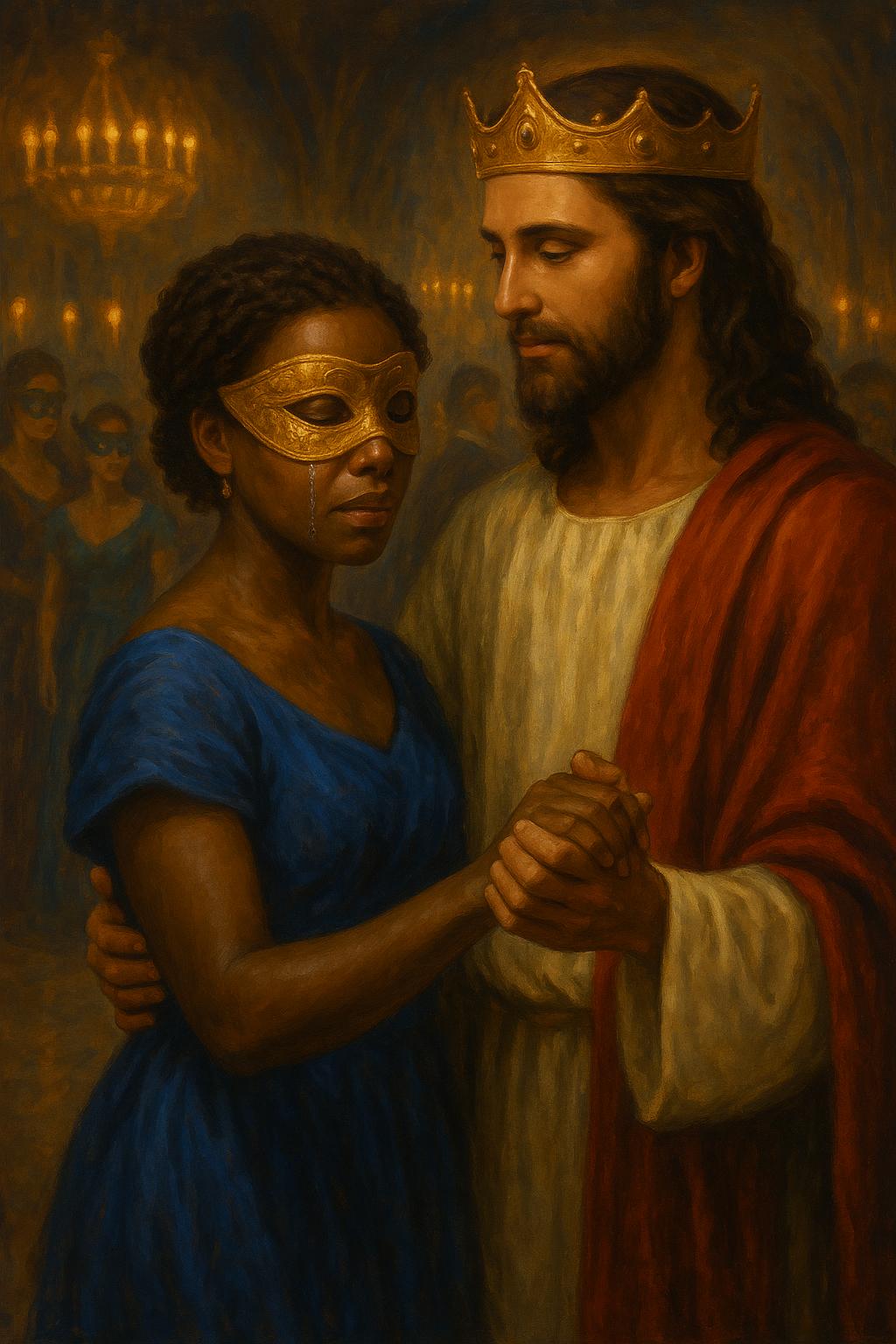
The night of the dance arrived. I sat quietly in a corner, watching gowns shimmer under the lights, masks glittering across faces. Girls squealed with excitement as their dates arrived, laughter echoing through the hall.
I sat still in my dress, heart heavy—until I felt a gentle yet priestly shadow over me.
A hand stretched out toward mine.
“May I have this dance?” the voice asked. It sounded like deep waters, yet engulfed in love.
I looked up, confused. Me? Of all people?
I hesitated, then nodded. Slowly, I placed my hand in His.
He spun me gently, never taking His eyes off me.
And then, to my surprise, He lifted my mask. My heart raced. Tears welled up. I expected Him to look away. But He didn’t. His gaze was steady. Kind. He looked at me as though He formed me.
As the music played, a voice sang. “You’ve been watching over me like no one else could do…”
I cried into His shoulder. Each tear carried memories, pain, rejection, and lies. And with each cry, more masks shattered.
Then, I saw it.
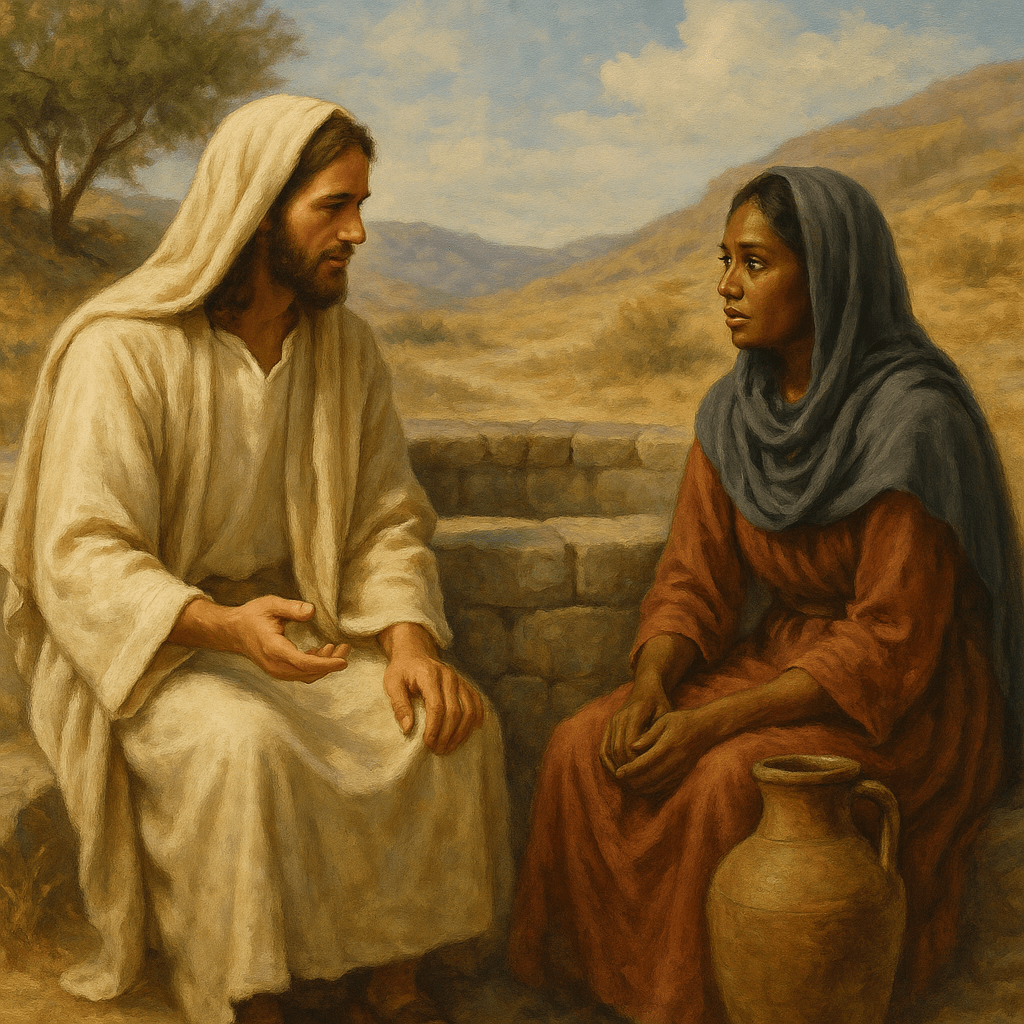
Behind Him, a door stood open. Beyond it, I saw a dry, barren land—Samaria.
Suddenly, we were no longer at the dance.
There, at a well, stood a woman. She was veiled, her eyes tired, her perfume trying to cover up her pain.
“Will you give me a drink?” Jesus asked her.
“You are a Jew, and I am a Samaritan woman,” she replied. “How can you ask me for a drink?”
(John 4:9)
He answered, “If you knew the gift of God, and if you knew who it is that asks you for a drink, you would have asked Him. He would have given you living water.”
(John 4:10)
The woman was stunned. “Sir, give me this water so that I won’t get thirsty again…”
(John 4:15)
Then Jesus said, “Go, call your husband.”
“I have no husband,” she replied.
“You’re right,” He said. “You’ve had five husbands, and the man you now have is not your husband.”
(John 4:16–18)
He saw her. All of her. And still, He stayed.
She tried to change the topic. “Our ancestors worshiped on this mountain, but you Jews claim the place to worship is in Jerusalem.”
(John 4:20)
Jesus replied, “A time is coming when true worshipers will worship the Father in spirit and in truth. Indeed, the Father seeks such to worship Him.”
(John 4:23)
“I know that Messiah is coming,” she said.
“I, the one speaking to you—I am He.”
(John 4:25–26)
Tears filled her eyes. Her past exposed, her shame uncovered—yet her true self unraveled .
She dropped her water jar and ran. Ran to the very people who had judged her.
“Come, see a man who told me everything I ever did. Could this be the Messiah?”
(John 4:29)
And I heard Him say to me,
“That’s what I want you to do. In worship, you are unraveled before Me. In worship, I reveal who I am—and in Me, you discover who you truly are.”
He looked me in the eyes. Then he whispered, “Leave your past with me. Look on to what I’m doing with you”.
And so I did.


 theahava.blog
Leave a comment